Most of the operations on a lathe remove metal — turning, facing, threading, grooving all peel a chip off the bar. Knurling does the opposite. It does not cut the surface so much as push it into shape, displacing metal with a hardened wheel that is forced into the workpiece under pressure. That single difference is why knurling feels like a black art to anyone who has not done much of it. The wheel does not shear the way a turning insert does, so the rules that govern speed and feed change completely, and the result — a crisp diamond or straight pattern used for grip on a thumb screw, a knob, a press-fit pin, or a handle — depends far more on pressure, diameter, and setup rigidity than it does on any cutting parameter. Get those three right and a knurl comes out sharp and even every time. Get one wrong and you get a smeared, double-tracked, flaked mess that looks hand-made.
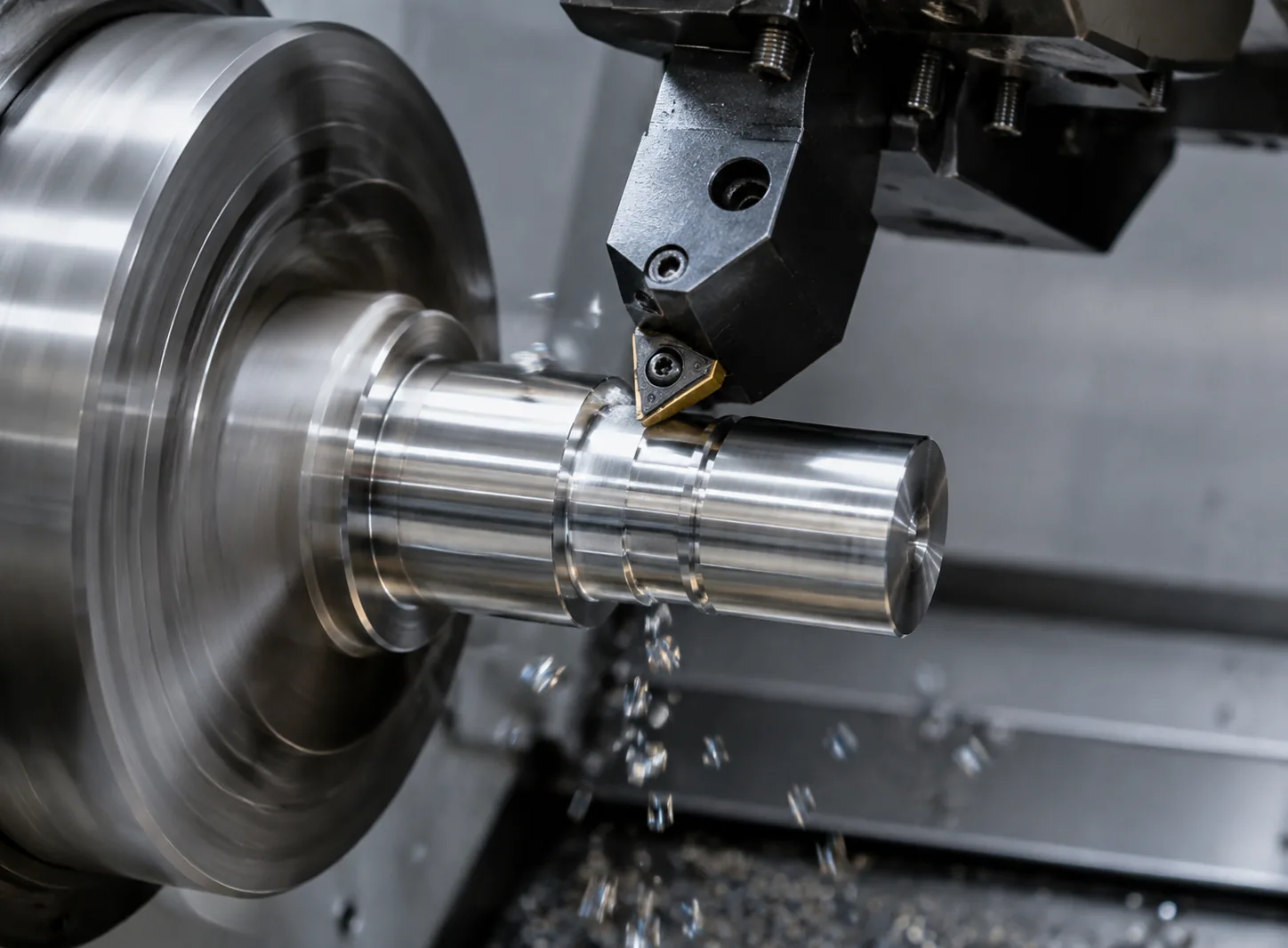
Knurling is forming, not cutting
A knurling tool carries one or more small wheels, each with a pattern of teeth ground around its rim. The wheel is pressed against the rotating workpiece with enough force that the teeth sink into the surface and displace metal, leaving an impression of the wheel's pattern behind. No chip is produced, at least not in the way a cutting tool produces one; the material flows and is pushed aside and upward between the teeth. That is why knurling is classified as a forming operation rather than a cutting operation, and it is why the process behaves so differently from everything else you do on a lathe.
The first consequence is the force involved. Because the wheel displaces metal instead of shearing it, the radial load on the part and on the machine is far higher than the load from a comparable depth of cut in turning. A knurling operation on a solid bar can push the workpiece, the toolpost, and even the cross-slide hard enough to flex them. This is why knurling has a reputation for being hard on lathes. It is not that the process is mysterious; it is that most lathes are simply not built rigid enough to take the load comfortably, and an operator who treats knurling like a light finishing pass will watch the tool chatter and the pattern smear.
The second consequence is that the surface finish is not a function of feed per revolution in the usual sense. In turning, a finer feed and a sharp tool give a smoother finish. In knurling, the pattern itself is the finish. What matters is whether the wheel tracks cleanly over the part and whether every tooth lands in the groove left by the previous pass. That tracking, in turn, is set by the relationship between the wheel pitch and the workpiece diameter.
Straight, diamond, and diagonal patterns
Knurls come in a few basic geometries, and they are not interchangeable. A straight knurl runs its teeth parallel to the axis of the part and produces axial ridges, the kind you see on a press-fit pin or a thin knurled band meant to grip a bore. A diamond knurl is produced by two wheels, one cut with a left-hand helix and one with a right-hand helix, run together so their impressions cross and form a diamond mesh. A diagonal knurl is the single-wheel cousin, one helix only, and it shows up on parts that need a directional grip or a purely decorative texture.
Diamond is the workhorse because it grips in every direction and looks deliberate. It is also the most demanding to set up, since two wheels have to track together and the depth of each impression has to match the other or the diamond comes out lopsided. Straight knurling is simpler and cheaper to tool, and it is often the right call on a part where the load is radial — a pin pressed into a hole — rather than rotational, as on a knob or a handle.
The choice is driven by function, not by taste. A thumb screw that a finger turns wants diamond or straight; a splined-like press fit wants straight; a decorative ring on an instrument body wants whatever the drawing calls out. The wrong pattern will not fail the part mechanically in most cases, but it will fail the intent, and on a grip surface the difference between a sharp diamond and a dull straight ridge is the difference between a knob that holds and one that slips in a greasy hand.
Diameter and pitch: why the circumference has to divide evenly
Here is the detail that separates a clean knurl from a double-tracked one, and it is pure arithmetic. As the wheel rolls around the part, each tooth wants to land in the groove left by the tooth that went before it. For that to happen, the circumference of the workpiece has to be an exact whole-number multiple of the wheel's pitch. If the circumference divides evenly, every tooth tracks the previous one and the pattern is clean. If it does not, the teeth drift by a fraction of a pitch each revolution, and within a few turns the wheel is cutting a second, offset set of grooves right on top of the first. The result is what machinists call double tracking — a knurl that looks fuzzy, smeared, or doubled, with the peaks broken off and no clean diamond anywhere.
In practice the fix is to size the diameter to the pitch, not the other way around. A knurl wheel is sold at a fixed pitch, usually specified in teeth per inch or in a metric pitch in millimetres, and the part diameter has to be turned to suit it. If a nominal drawing diameter does not track cleanly, the part is turned a few thousandths under or over until the circumference is a clean multiple of the pitch. This is why a knurled diameter on a print often carries a looser tolerance than the rest of the part — the exact size is decided at the machine by the pitch of the wheel, not by the decimal on the drawing.
Cut knurling, where a hardened cutter actually shears the pattern into the work, sidesteps some of this because it cuts rather than forms and is less sensitive to diameter mismatch. But form knurling remains the common method on manual and many CNC lathes, and for form knurling the diameter-to-pitch relationship is non-negotiable.
Pressure, feed, and the forces that fight the machine
Knurling pressure is the setting most people get wrong. The wheel has to be driven into the work hard enough that the teeth reach full depth and form complete peaks, but not so hard that the part deflects, the tool flexes, or the metal over-flows and flakes at the edges of the knurl. Too little pressure and the pattern is shallow and washed out, with the peaks rounded over and the diamonds half-formed. Too much and the crests break, the metal smears, and on a thin-walled part the wall itself can bulge or collapse.
Feed is the second lever. A slow, steady feed gives the teeth time to seat and produces a cleaner pattern; feed too fast and the wheel skips, leaving a rippled, uneven knurl. On a CNC lathe the feed is programmed, but the same principle holds: a moderate feed matched to the wheel pitch and the workpiece diameter keeps the teeth engaged without bouncing. Speed is less critical than in cutting, but it should be kept low enough that the wheel does not skid and gall the surface, and high enough to keep the operation moving.
Rigidity is the quiet partner in all of this. Because forming forces are high, the tool has to be on center, the toolpost tight, and the part supported so it cannot climb the wheel. A part that sticks out too far from the chuck will deflect under the knurl pressure and produce a tapered or shallow pattern at the free end. This is the same rigidity problem that governs any heavy forming or cutting operation, but knurling punishes it harder because there is no chip to carry the force away — the whole load stays in the part and the tool.
| Setup element | What it controls | Why it matters |
|---|---|---|
| Wheel pitch vs diameter | Clean tracking, no double tracking | Circumference must divide evenly by pitch |
| Knurl pressure | Depth and definition of the peaks | Too light washes out, too hard flakes the crest |
| Feed rate | Evenness across the knurl width | Too fast skips teeth and ripples the pattern |
| Tool on-center height | Balanced tooth engagement | Off-center loads one flank and smears the other |
| Part support / stick-out | Rigidity under forming load | Long stick-out deflects and tapers the knurl |
| Lubrication | Surface galling and wheel life | Forming is metal-on-metal; dry runs gall |
Material, hardness, and wheel wear
The material decides how forgiving the process is. Free-machining materials and soft aluminum knurl easily, displace metal cleanly, and forgive a slightly off diameter. Stainless steel, titanium, and work-hardening alloys are the other end of the scale — they resist displacement, they work-harden under the wheel, and they punish an operator who lingers too long on one spot. On a hard material the wheel itself wears, the teeth lose their edges, and a wheel that once cut a sharp diamond starts producing a dull, rounded one.
Aluminum 6061-T6 is the material knurling is most associated with in a shop that does consumer parts and knobs, and it is a good one: it forms readily, holds a sharp pattern, and anodizes well afterward. The one caution is that knurling raises a small burr at the edges of the knurl, and on aluminum that burr is easy to fold over into the pattern if the part is handled before it is deburred. A light edge break after knurling, done carefully so it does not flatten the peaks, keeps the part clean without wrecking the grip.
Wheel wear is a slow, quiet failure. A knurl wheel is a hardened, ground tool, and it lasts a long time on easy material, but once its teeth start to round, the only fix is replacement. There is no resharpening a form wheel back to a crisp profile, and running a worn wheel just produces progressively worse parts while the operator compensates with more and more pressure. Watching the pattern, not the clock, is the way to know when a wheel is done.
Common defects and how to fix them
Almost every knurling defect traces back to one of three causes: a diameter that does not divide evenly, a pressure setting that is wrong, or a rigidity problem. Double tracking is the diameter problem, and the fix is to turn the part to a size that tracks the wheel pitch. A washed-out, shallow pattern is a pressure problem, and the fix is more pressure — or, more often, a check that the tool is on center and the part is not flexing away from the wheel. A smeared or flaked pattern with broken crests is usually over-pressure or a dull wheel, and the fix is to back the pressure down or replace the wheel.
Chatter deserves its own mention. Knurling chatter sounds like a loud, rhythmic buzzing and leaves a pattern of periodic light and dark bands around the part. It is almost always a rigidity failure — too much stick-out, a loose toolpost, or a lathe that is simply too light for the load — and the cure is to stiffen the setup, shorten the stick-out, or slow the spindle. Adding pressure to fight chatter makes it worse, not better, because the extra load increases the flex that causes the vibration in the first place.
The single most useful habit is to cut the first part, stop, and look at it under magnification before running the batch. A knurl that is going wrong shows it in the first revolution of the first part. Catching a double track or a shallow pattern on part one costs a few minutes and a piece of scrap; catching it on part five hundred costs the batch.
- Size the diameter to the wheel pitch — the circumference must divide evenly or the knurl double tracks.
- Keep the tool dead on center — an off-center wheel loads one flank and smears the other.
- Set enough pressure to form full peaks — too light washes the pattern out.
- Do not over-pressure — too hard flakes the crests and can bulge a thin wall.
- Feed slow and steady — a fast feed skips teeth and ripples the knurl.
- Minimize stick-out — the forming load deflects a long unsupported part.
- Lubricate the wheel — metal-on-metal forming galls when run dry.
- Deburr the edges without flattening the peaks — keep the grip sharp.
- Inspect the first part under magnification — catch a bad knurl before the batch.
"Knurling looks simple because nothing is being cut, but the whole operation turns on three things most cutting jobs never ask about: the diameter has to divide evenly by the wheel pitch, the pressure has to be enough to form the peaks without flaking them, and the setup has to be rigid enough to hold the part against a load that stays in the metal instead of leaving with a chip. Get those three right and a knurl is a five-second operation. Get any one wrong and you will fight it all afternoon."
A knurl is one of the few lathe operations where the part is made by what you push into it rather than what you take off it. That reversal changes the rules: the diameter is set by the pitch, the quality is set by the pressure, and the finish is the pattern itself. Once those rules are understood, knurling stops being a black art and becomes a predictable, repeatable step — and a sharp diamond pattern is exactly the kind of detail that makes a machined part feel finished rather than just made.
If your parts carry knurled grips, thumb screws, press-fit pins, or decorative knurled bands that keep coming back double-tracked or washed out, send the drawings over and we will look at the pitch, the diameter, and the setup together. See how we handle turned and finished parts and Swiss-style turning for small precision work, or get a quote on your part.